Internship & Volunteering
Internship & Volunteering
Gain hands-on experience working with local experts in Peru.
Are you interested in an internship with ANDES to gain hands-on experience working with local experts in Peru?
We offer internship programs for university studies in a range of academic disciplines, where you will explore themes such as biodiversity conservation, potato diversity, Indigenous-led climate change adaptation and knowledge preservation, and much more.
We also welcome volunteers who wish to engage meaningfully with the Indigenous communities we partner with, learning directly from their traditions, innovations, and worldviews.
Please email info@andes.org.pe to learn more about available opportunities. We look forward to welcoming you to ANDES!
Housing Options - Internship ANDES
There are different ways to find accommodation in and around Cusco during your internship with Andes. Monthly accommodation costs vary about between S/ 250 and S/ 1800 (about 70$ and 480$). Below you can read descriptions of the city of Cusco, Pisac and Calca, which are very different places and all have their own charm. Where you choose to live during your internship depends on you and your personal and professional interests. From all these places you can do your internship at Andes and all the working places like the office in Huaran and the parks are accessible from these places. In the tables below we have compiled some possible accommodation options that may help you to find a suitable accommodation for you.
Please email info@andes.org.pe to know about a list of options for housing, their prices and manager contact
Cusco


Cusco is a very lively city with about 428,500 inhabitants and several tourists throughout the year. There is a lot to discover, such as beautiful old architecture, restaurants and bars, especially in the historic centre and around the Plaza de Armas. There are different museums, markets, and shops where you can find everything you need. At the San Pedro market, for example, you can eat out, buy food, or nice souvenirs. The districts in the centre around the Plaza de Armas, like San Blas or the Centro Historico, offer several hotels and accommodations, but are also more expensive than other districts.
In Cusco, accommodation costs vary between 500 and 1000 Soles. There are several hotels and hostels where interns can stay. For the first few days, we recommend booking accommodation directly after arrival in Cusco via the internet. This can be done through popular websites such as Airbnb or booking.com. For longer stays, a room or a flat can be found either through the Facebook Marketplace or groups (Expats Cusco – Peru / Alquiler y Anticresis Habitaciones, Mini – Departmentos Cusco), private contacts directly in the districts, or through the mentioned websites. We can recommend the following housing options with single rooms.
Pisac
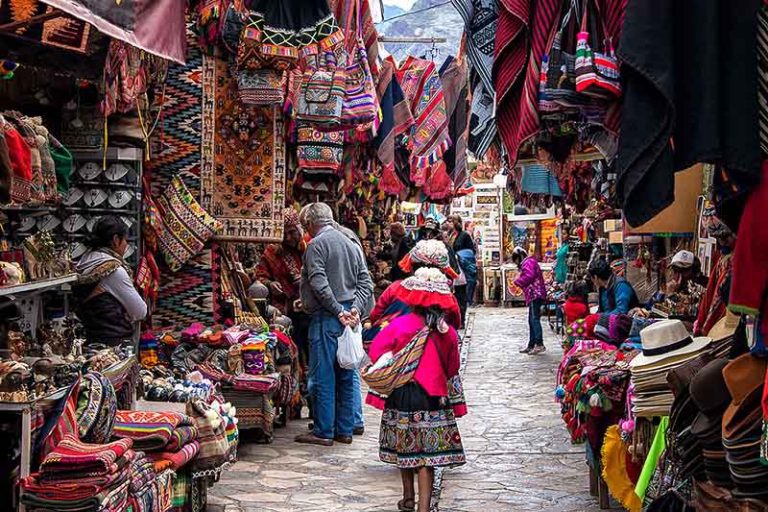

Pisac is about 40 minutes by car from Cusco in the Sacred Valley and costs S/5 by public transport and S/ 50 by taxi one way. Pisac has about 10.000 inhabitans in total and is located on the Urubamba River, surrounded by beautiful, green mountains. Directly accessible there are several hiking trails and many opportunities to be close to nature. It is village-like with a centre where you can buy everything you need, such as a food market, handicraft market, supermarkets and pharmacies.
There are also several restaurants and shops selling organic, vegan products. Public buses depart from Pisac to Cusco, Parque de la Papa, Calca, Huaran, and Urubamba. From Pisac, you can reach the Parque de la Papa in 30 minutes and the office in Huaran in 40 minutes.
Accommodation costs from S/ 300 (about 80$) up. There are several hostels, hotels, and guesthouses where you can stay for weeks or months. You can also search for flats or rooms on the internet, such as the Facebook Marketplace or the Facebook group „Pisac, Pisac, all events“. We have listed several housing options for Pisac. The different accommodations are located in the small centre or outside in quieter areas.
Calca


Calca is a small town in the Sacred Valley. Calca is predominantly a local town and less touristy, so if you want to meet local people in Calca, you have the possibility. It is a quiet place with a green centre with several shops, restaurants, and a market. Also, from Calca, nature and the mountains are not far away, and there are several hiking trails. The town has a central bus station and is well accessible by public transport. To Pisac it‘s about 30 minutes and costs S/ 5 and to the office of Andes it‘s 10 minutes by bus from Calca in the direction of Urubamba and costs about S/ 2.
In Calca, there is also the opportunity to search for rooms or flats on Facebook Marketplace. Accommodations in Calca are cheaper and vary between S/ 250 and S/ 400 (about 70$ and 110$) per month. The accommodations are, in general, more basic, but the people who offer them are very welcoming. We can recommend the following accommodations.
Heritage-led Planning for Rural Community Resilience: Terrace Landscapes in Peru (2021).
Author: Bhattacharya, Sampoorna - University of Guelph, MSc Rural Planning and Development.
Year: 2021
Keywords: community development, rural studies, terrace agriculture, conservation, Parque de la Papa

Mobilizing Development Alternatives: The Engagement of Sumaq Kawsay, or ‘Harmonious Living’ in the Peruvian Andes (2023)
Author: Bennett, Sammi - University of Oxford, Master of Philosophy in Development Studies
Year: 2023
Keywords: Sumaq Kausay, development, Harmonious Living, The Peruvian Andes

¿Hasta Qué Punto Los Territorios Indígenas Pueden Y Deben Seguir “Desarrollándose”? (2024)
Author: Blanc, Manon - L’Institut d'Études Politiques de Lyon
Year: 2024
Keywords: Sumaq Kausay, development

Through an Indigenous Lens Food Security is Food Sovereignty: Case Studies of Maori of Aotearoa New Zealand and Andeans of Peru
Author: Huambachano, Mariaelena.
Year: 2016
Keywords: Indigenous knowledge, traditional ecological knowledge, sumaq kawsay, food sovereignty
Participatory Curriculum Development: Facilitating Learning for Social Change in the Andes
Author: Stenner, Tammy - University of Athabasca, MA Integrated Studies.
Year: 2015
Keywords: Education, toolkit, indigenous literacies, Pluriversity
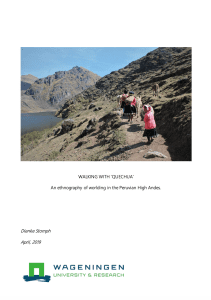
Walking with Quechua: An Ethnography of Worlding in the Peruvian Andes
Author: Stomph, Dienke.
Year: 2019
Keywords: Posthuman anthropology, multispecies interaction, place-making, traditional knowledge
Tourisme et Reduction de la Pauvrete: Etude des Impacts Socio-Economiques de L Agro-Ecotourisme du Parque de la Papa
Author: Terry, Cristian - Graduate Institute of International and Development Studies, Geneva
Year: 2011
Keywords: Tourism, community development, Parque de la Papa
How Quechua Communities are Preserving Crop Biodiversity through Non-Competitive Markets, and the Resulting Impacts on Food Systems
Author: Hawes, Leah - University of Sussex, institute of Development Studies, MA Food and Development Studies
Year: 2022
Keywords: biodiversity, alternative markets, food systems
Bridging Knowledge Systems In The Peruvian Andes: Plurality, Co-Creation And Transformative Socio-Ecological Solutions To Climate CHANGE
Author: Domenique Ciavattone - SIT Graduate Institute, USA, Master of Arts in Climate Change and Global Sustainability
Year: 2022
Keywords: traditional knowledge, co-creation, socio-ecological solutions, plurality
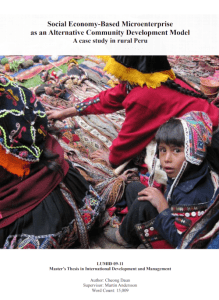
Social Economy-Based Microenterprise as an Alternative Community Development Model: A Case Study in Rural Peru
Author: Duan, Cheong - Lund University, MA International Development and Management.
Year: 2011
Keywords: community development, tourism, microenterprises, Parque de la Papa
Escalating Tensions:The Emerging Relationship Between Intellectual Property Rights and Indigenous Rights in Peru
Author: Greenwood-Sanchez, David. - University of Minnesota, Master of Public Policy (MPP)
Year: 2011
Keywords: Human rights, intellectual property, indigenous rights, Parque de la Papa<
Decolonization as Relocalization: Conceptual and Strategic Frameworks of the Parque de la Papa, Qosqo
Author: Grey, Sam - University of Victoria, MA Human and Social Development.
Year: 2008
Keywords: Decolonization, Andean politics, place-making, governance, Parque de la Papa
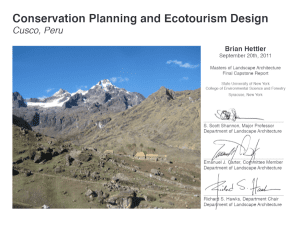
Conservation Planning and Ecotourism Design
Author: Hettler, Brian - State University of New York, Master of Landscape Architecture.
Year: 2011
Keywords: Community development, ecotourism, cultural heritage, Parque de la Papa
Criar y Dejarse Criar: Trans-Situ Crop Conservation and Indigenous Landscape Management through a Network of Global Food Neighborhoods
Author: Madden, Cass - SIT Graduate Institute, MA Climate Change and Global Sustainability.
Year: 2019
Keywords: Plant genetic resources, spatial modeling, biocultural heritage, Parque de la Papa
La Multidimensionalidad de los sistemas locales de alimentación en los Andes peruanos : los chalayplasa del Valle de Lares (Cusco)
Author: Martí Sanz, Neus - Universitat Autònoma de Barcelona, PhD Ciencias Ambientales.
Year: 2006
Keywords: Barter markets, traditional knowledge, food sovereignty, agroecosystems, Lares Valley
Climate change and Peruvian potato farming: Traditional knowledge in climate change adaptation
Author: Giamberso, Lisa Rose. - University of Oregon, B.A. Environmental Studies.
Year: 2014
Keywords: thesis, potato park, parque de la papa, traditional ecological knowledge
Development, Interculturality and Power: Translating an NGO-Led Development Intervention in The Peruvian Andes
Author: Chichizola Ramirez, Bruno Enrico - University College of London, PhD Development Planning.
Year: 2020
Keywords: interculturality, development practice
Resilient Biocultural Heritage Landscapes for Sustainable Mountain Development, INMIP, Peru
Author: Swiderska, Krystyna - Coventry University, PhD Agroecology, Water, and Resilience.
Year: 2017
Keywords: Biocultural Heritage Territories, decolonization, upscaling, food sovereignty
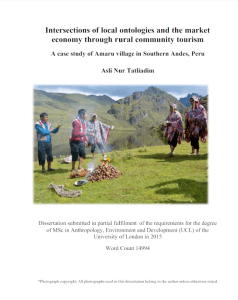
Intersections of local ontologies and the market economy through rural community tourism A case study of Amaru village in Southern Andes, Peru
Author: Tatliadum, Asli Nur - University of London, MSc Anthropology, Environment and Development.
Year: 2015
Keywords: Sustainable tourism, community development, neoliberalism, Parque de la Papa
Por Eso Cuidamos Una Investigacion Sobre las Motivaciones Culturales Andinas que Incentivan a la Gente Indigena local a Conservar la Naturaleza en el Parque de la Papa, Pisac, Peru
Author: Yanuck, Sarah - SIT Study Abroad
Year: 2013
Keywords: conservation, traditional knowledge, Parque de la Papa